Date: September 16, 2025
Contact: Katie Gustainis, media@arcwa.org, 940-390-3039
The following statement in response to the DSHS budget requests released on September 14, 2026 may be attributed to Stacy Dym, Executive Director of The Arc of Washington State, the state’s oldest grassroots organization advocating for the rights and inclusion of people with intellectual and developmental disabilities (IDD) and their families since 1936:
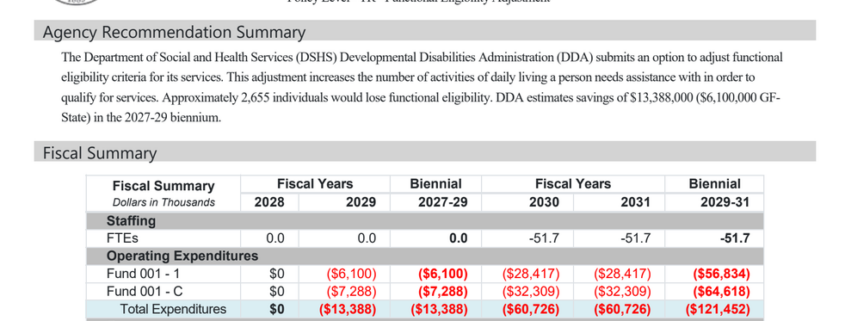
“The Department of Social and Services (DSHS) is proposing to change the eligibility requirements to narrow the number of people who qualify for disability services – unfortunately, they are clear-eyed about the catastrophic impacts these changes will have for the 2,655 identified individuals with disabilities who would no longer qualify for support.
The implication that these cuts will save the state money is deeply misleading. The Developmental Disabilities Administration (DDA) explicitly calls out the expected impacts in their budget request:
‘The most serious consequence falls on clients residing in residential facilities because their housing is contingent upon their eligibility. For clients who have no home to return to, no available family or informal caregiver, and insufficient income to maintain housing, loss of eligibility may result in housing insecurity.’
Although similar eligibility changes were proposed last year, the legislature refused to accept them despite facing yet another difficult budget debate. It is incredibly frustrating to see DSHS bring this proposal back to the table.
Individuals with intellectual and developmental disabilities (IDD) rely on essential services from a network of state and federal agencies in order to live in their community free from isolation and institutional care. Unfortunately, cutting community services will end up costing the state and taxpayers more. A reduction in the number of people with disabilities who can receive Home and Community Based Services (HCBS) will simply shift and multiply those costs as thousands of individuals are pushed into crisis and end up in hospitals, more expensive congregate settings, or unfit environments for their care.
Changes to eligibility like this proposal call into question Washington state’s commitment to serving our most vulnerable residents in the most integrated setting appropriate to their individual needs. It was just two weeks ago that Governor Ferguson publicly condemned the federal government’s actions that are risking the return of involuntary institutionalization for people with disabilities. And as his office warns people about the impending Medicaid cuts, these state eligibility changes will actually cause the loss of Medicaid eligibility for hundreds of families, adding salt to the wound.
Unfortunately, the proposed agency requests did not include any proposed savings by transitioning the residents of the increasingly expensive Residential Habilitaiton Centers (RHCs) to more affordable and appropriate care in their communities – an option that reduces costs and ensures no one loses services. This proposal puts thousands of individuals at risk of institutionalization and demonstrates how desperately Washington needs to enshrine the right to community-based care into law before the federal government completely erodes it.”
For reference:
Developmental Disability Administration (DDA) Decision Package: https://drive.google.com/file/d/1i6Z-40vaHhOu6FFNHwDvaEazFAKunYB6/view
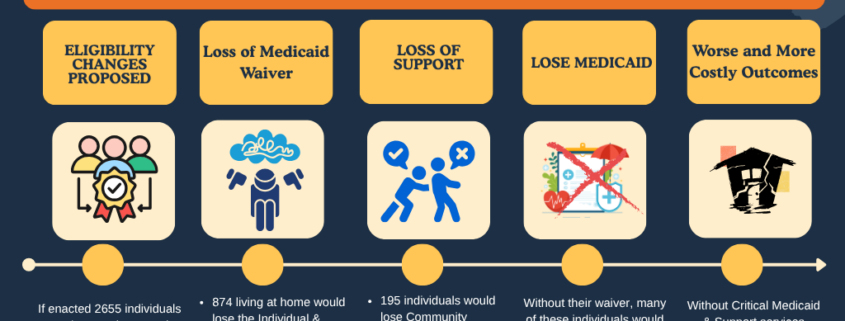
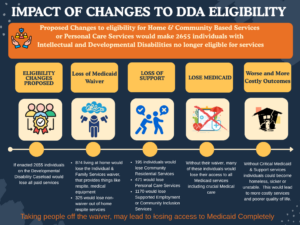
According to the DDA Decision Package, 2655 distinct individuals would no longer qualify for services
- 195 adults/children currently receiving Community Residential Services or a State Operated Community Residential
- 471 individuals receiving personal care
- 874 individuals receiving Individual & Family Services Waiver (living with families)
- 1170 receiving Supported Employment and/or Community Inclusion Services
- 325 individuals receiving non-waiver respite, out-of-home respite, respite in an AFH, or Licensed staff residential
Unknown at this time:
- The number of DDA individuals in Adult Family Homes that would lose services
- The number of DDA individuals who would lose access to Medicaid with loss of the waiver.
Home and Community Living Administration (HCLA) Decision Package: https://drive.google.com/file/d/1RZzHycQwP-x4hXIc9JCWIbmb7LUhYMPx/view
About The Arc of Washington State
The Arc of Washington State is the state’s oldest grassroots organization advocating for the rights and inclusion of people with intellectual and developmental disabilities (IDD) and their families for over 90 years.
In 1936, The Arc of Washington State was formed by parents of institutionalized children with intellectual/developmental disabilities (IDD) who believed their children deserved more – to be included in their communities and to pursue fulfillment and happiness just like everyone else. The Arc’s mission is to promote and protect the human rights of people with intellectual and developmental disabilities and actively support their full inclusion and participation in the community throughout their lifetimes. Learn more at arcwa.org .
Contact: Katie Gustainis, media@arcwa.org, 940-390-3039
—