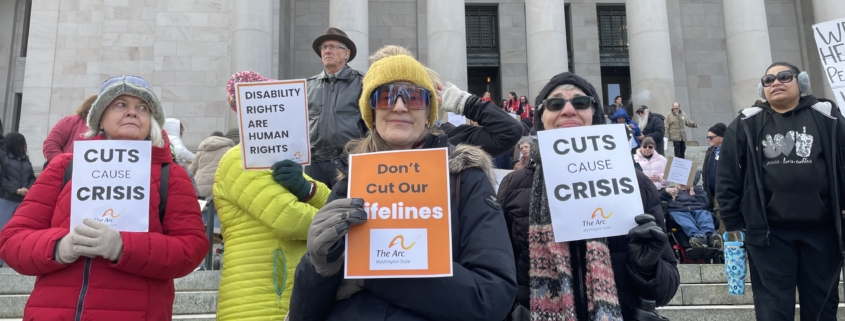
Tell the Governor to direct DSHS: We Cannot Cut Parent to Parent

[Español abajo]

We need your help now. We just received unexpected news that Washington’s statewide Parent to Parent (P2P) program is at risk of losing its contract as soon as 30 days from now after 45 years of successful operation. This program is a vital resource and we cannot lose it, especially now.


If P2P is cut, families of children and adults with intellectual and developmental disabilities in all 39 Washington counties will lose their lifeline of peer support and system navigation. This cut is happening with no public announcement, no legislative vote, and no chance for families to weigh in before it’s gone.


It’s not the legislative session; can they make cuts?

The Governor has directed DSHS to look at all their programs and consider cuts they can make now without legislative directive because the budget outlook for the state is very grim.  Parent to Parent has been targeted for scrutiny.


Why Parent to Parent matters:

  • Peer support from experienced parents (“been there, done that”) provides immediate emotional relief and practical guidance at diagnosis and throughout the life course.
  • P2P helps families navigate complex systems (education, health, social services), preventing crisis and reducing long-term public costs.
  • It’s a high-impact, low-cost program that reaches families statewide — exactly the kind of investment the state should protect.

Last year’s Parent to Parent impact in Washington:

  • 92,858 calls, emails, and connections with families
  • 5,879 contacts provided in languages other than English
  • 1,056 trained parent volunteers; 622 parent support matches facilitated
  • Mailing lists reached 64,536 parents and professionals; 50+ coordinators covering every county
  • 14 dedicated multicultural support programs (including Latino and African American outreach)

This is a cut, even without a headline. Letting a contract lapse produces the same result as a budget cut — but skips the transparency and public process a formal cut would require.


P2P is grounded in state law and has been part of Washington’s core family support infrastructure since 1980. Ending the contract without legislative or public input undermines that statutory commitment.  This especially hurts rural families and families experiencing crisis.


Families are the long-term care support for individuals with developmental disabilities – tell the Governor families need to be supported. 


What to do — Tell the Governor to direct DSHS: “We cannot cut Parent to Parent. We must continue the statewide contract so families can keep vital peer support and navigation services.”

Take Action Now

  • First, click to use our email tool to send a message directly to the Governor and your legislators.
  • You can also call the Legislative Hotline to leave the Governor and your 3 legislators  a message at 1-800-562-6000
  • If you have time, you can also leave a message for Washington State DSHS Secretary Angela Ramirez by calling Constituent Services at (800) 737-0617 or by sending an email to askdshs@dshs.wa.gov.

Cathy, please act now, or we may see P2P services ending before the summer is over.

Thank you for your advocacy, we couldn’t do it without you.

Cathy Murahashi

Public Policy Specialist

Pídale al Gobernador que instruya al DSHS:
¡No podemos recortar a Parent to Parent!


Necesitamos su ayuda ahora. Acabamos de recibir una noticia inesperada: el programa estatal Padre a Padre (Parent to Parent  o P2P) de Washington corre el riesgo de perder su contrato en tan solo 30 días, después de 45 años de operación exitos. Este programa es un recurso vital para las familias y no podemos permitir que desaparezca, especialmente en este momento.


Si se elimina Padre a Padre, las familias de niños, jóvenes y adultos con discapacidades intelectuales y del desarrollo en los 39 condados del estado de Washington perderán una fuente esencial de apoyo entre padres y orientación para navegar los sistemas de servicios. Esta reducción está ocurriendo sin un anuncio público, sin una votación legislativa y sin la oportunidad de que las familias expresen su opinión antes de que el programa desaparezca.


¿No estamos fuera de la sesión legislativa? ¿Aun así pueden hacer recortes?

El Gobernador ha instruido al DSHS (Departamento de Servicios Sociales y de Salud) a revisar todos sus programas y considerar recortes que puedan realizarse sin una directiva legislativa, debido a que las perspectivas presupuestarias del estado son muy preocupantes. Padre a Padre ha sido identificado para revisión y posible eliminación.


¿Por qué es importante el Programa de Padre a Padre (Parent to Parent)?

  • El apoyo entre padres con experiencia (“ya hemos pasado por esto”) brinda alivio emocional inmediato y orientación práctica desde el momento del diagnóstico y a lo largo de todas las etapas de la vida.
  • Padre a Padre ayuda a las familias a navegar sistemas complejos (educación, salud y servicios), previniendo crisis y reduciendo costos públicos a largo plazo.
  • Es un programa de gran impacto y bajo costo que llega a familias en todo el estado, exactamente el tipo de inversión que el estado debería proteger.

Este fue el Impacto del Programa Padre a Padre en Washington durante el último año

  • 92,858 llamadas, correos electrónicos y conexiones con familias.
  • 5,879 apoyos brindados en idiomas distintos al inglés.
  • 1,056 padres voluntarios capacitados; se facilitaron 622 conexiones de apoyo entre padres.
  • Las listas de distribución llegaron a 64,536 padres, familiares y profesionales.
  • Más de 50 coordinadores brindando cobertura en todos los condados del estado.
  • 14 programas multiculturales dedicados al apoyo familiar, incluyendo alcance a las comunidades latinas y afroamericanas.

Esto es un recorte, aunque no aparezca en los titulares. Permitir que un contrato expire produce el mismo resultado que un recorte presupuestario, pero evita la transparencia y el proceso público que requeriría una reducción formal.


Padre a Padre está respaldado por la ley estatal y ha sido parte fundamental de la infraestructura de apoyo para las familias en Washington desde 1980. Terminar el contrato sin participación legislativa ni consulta pública debilita ese compromiso legal. Esto afectará especialmente a las familias rurales y a las familias que están atravesando situaciones de crisis.

Las familias son el principal apoyo a largo plazo para las personas con discapacidades del desarrollo. Dígale al Gobernador que las familias necesitan y merecen apoyo.

Qué hacer:

Pídale al Gobernador que instruya al DSHS: “No podemos eliminar a Padre a Padre (Parent to Parent). Debemos mantener el contrato estatal para que las familias continúen recibiendo servicios vitales de apoyo entre padres y orientación para navegar los sistemas.”

Muchas gracias,

Cathy Murahashi

Public Policy Specialist

Looking Back at Our History: 90 years of The Arc

The first steps that built the Arc of Washington State

As part of our 90th anniversary, we are sharing some of the historical documents and artifacts that tell the story of how The Arc of Washington State began. These materials were originally collected and curated by former board member, the late Larry Jones, offering a glimpse into the people who came together to build the foundation of an organization that has now served Washington families for 90 years.

The language in these documents reflects the time in which they were written and does not reflect the language we use today. What hasn’t changed is the need for connection, advocacy, and community.

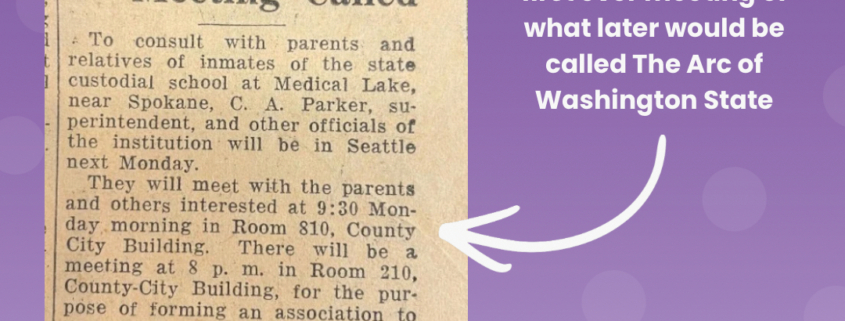
Beginning October 21, 1935, a group of parents gathered in Seattle to discuss forming an organization for families whose children lived at the State Custodial School, now know as Lakeland Village Residential Habilitation Center. This newspaper notice helped spread the word and brought together families who often felt alone in their experiences.

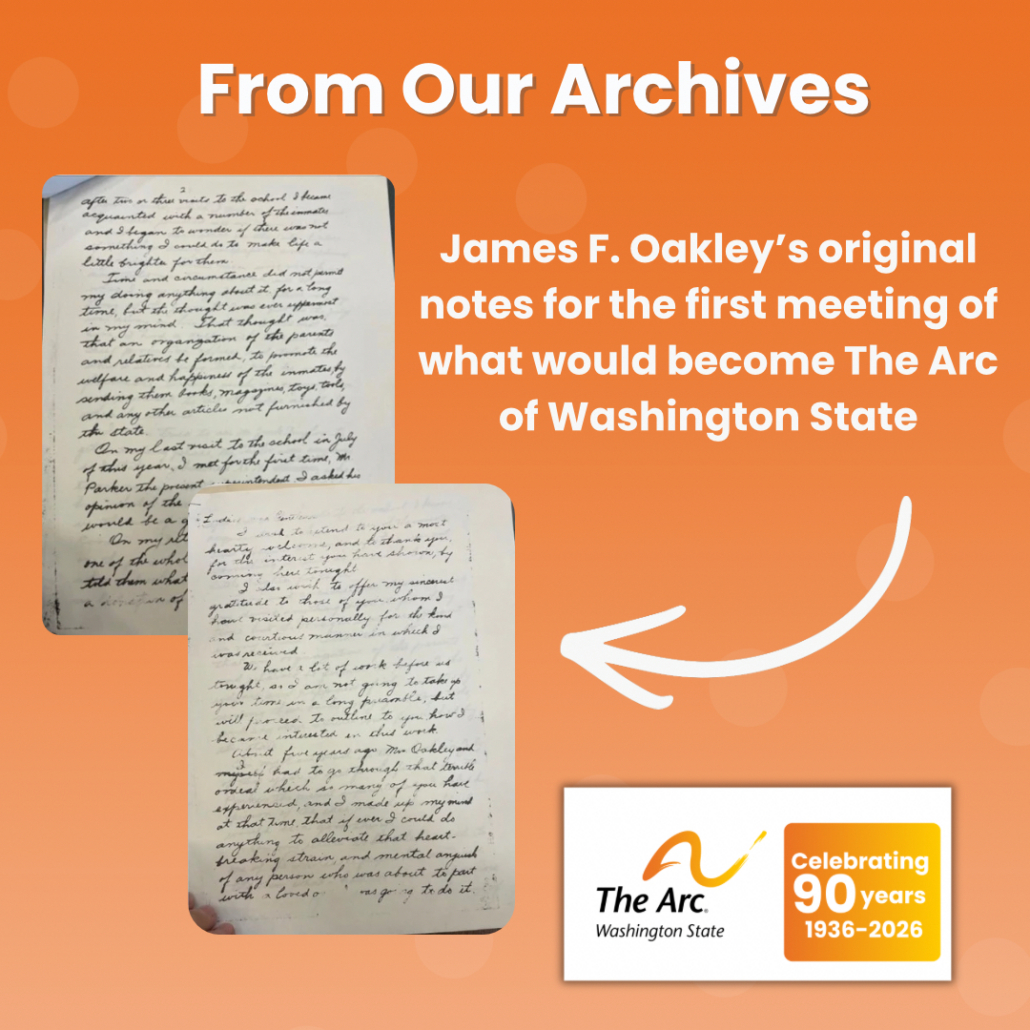
At the first meeting, James F. Oakley shared what inspired him to act after his own family’s experience. He spoke about wanting to help find ways to make life better for individuals living at the institution. His words reflect an idea that still resonates today: families are stronger when they support one another.

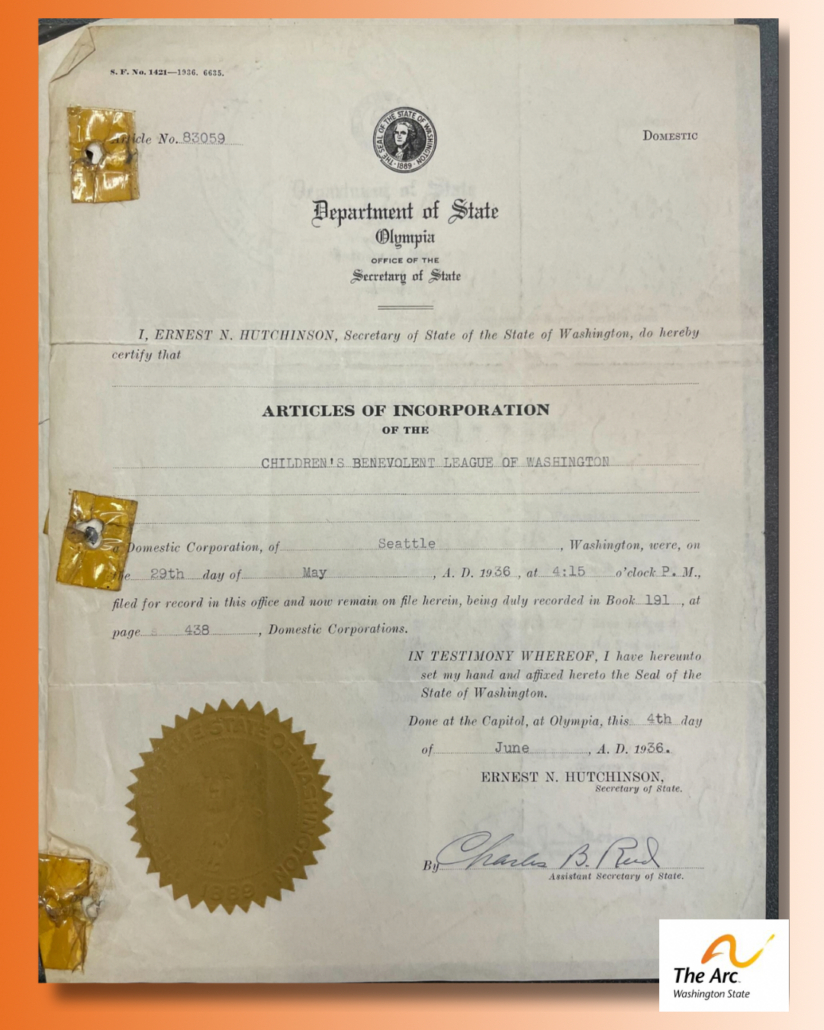
On June 4, 1936, the Children’s Benevolent League of Washington was officially incorporated by the State of Washington. That organization would later become The Arc of Washington State.

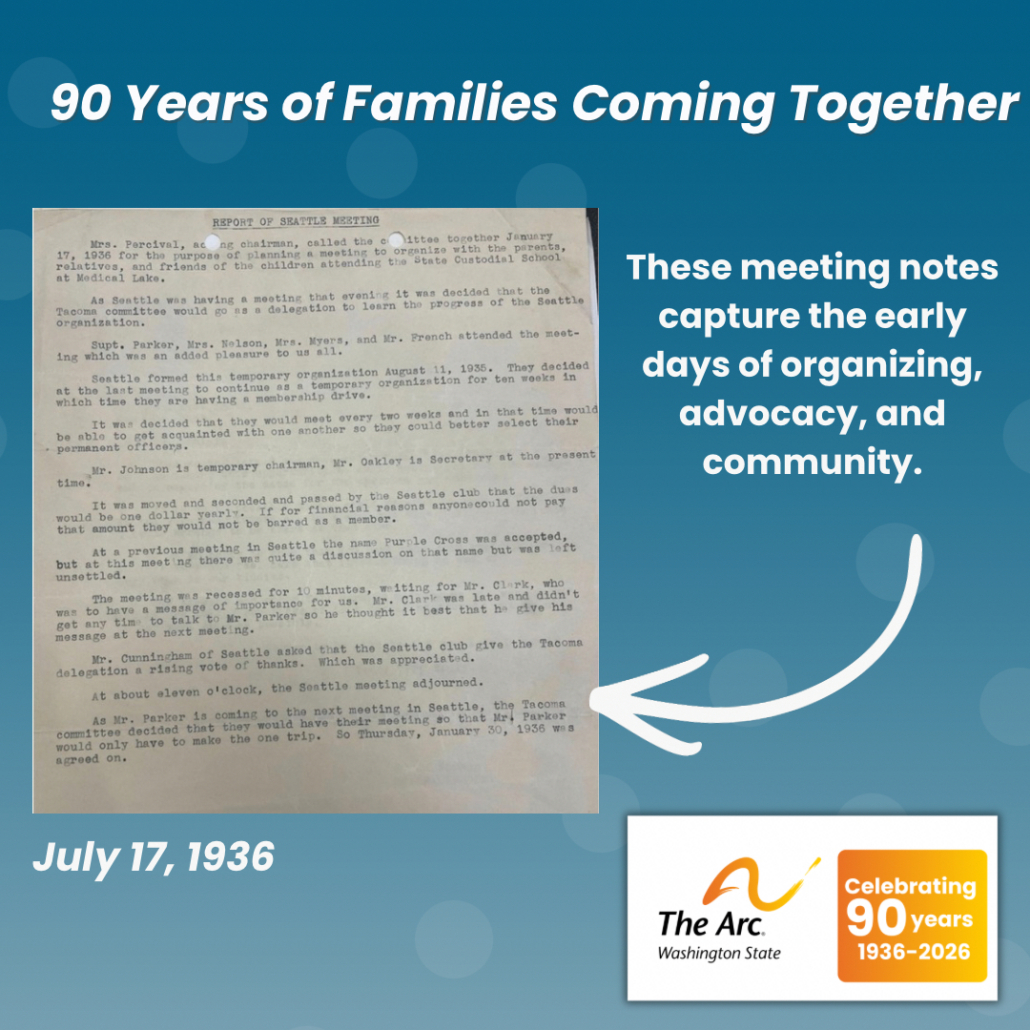
In July 1939, another set of meeting notes shows the grassroots work that followed the creation of the organization. Parents came together, made decisions, and built an organization one meeting at a time. These handwritten notes remind us of the lasting changes that often begin with people willing to show up and work together.

Ninety years later, The Arc of Washington State continues that work alongside people with intellectual and developmental disabilities, their families, and communities across the state.

Thank you for joining us in reflecting on these important moments in our history. As we continue to celebrate our 90th anniversary, we are reminded of our commitment to inclusion, advocacy, and belonging.

KING5 Story: Community services are essential

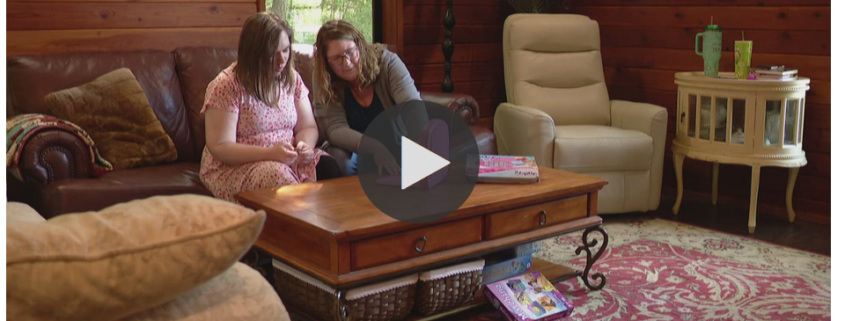
“I can guarantee that our family members are here caring for our loved ones…We’re not fraudsters.”

Sandi Gruberg and her daughter Marina are speaking up and out against the claims from HHS Secretary Kennedy that all caregivers receiving Medicaid payments are abusing the system. His comments set a dangerous precedent for threats to home and community-based services that are lifelines for thousands of families and their loved ones with disabilities.

Watch or read the whole KING 5 story and share with your community: https://www.king5.com/article/news/health/parents-of-adults-with-disabilities-fear-medicaid-cuts-after-rfk-jr-comments/281-af0d144e-7b62-47ea-b989-3b0b81b0f82a

Home and community-based services are under threat, especially in light of the latest memo from the Department of Justice that contradicts almost thirty years of established law stating that community services should always be the default, preferred option over institutional settings.

The Arc of the United States has published a helpful statement to clarify what is and isn’t changing and answering some important questions for those in Washington state who want to know more: https://thearc.org/blog/doj-opinion-on-olmstead-threatens-the-right-of-people-with-disabilities-to-live-in-the-community/ 

From The Arc of the United States:

“…the U.S. Department of Justice issued a legal opinion that threatens one of the most important civil rights protections for people with disabilities: the right to live and receive services in the community, not be unnecessarily confined to institutions.

The opinion targets Olmstead v. L.C., the 1999 U.S. Supreme Court decision that recognized institutional isolation of people with disabilities as discrimination under the Americans with Disabilities Act (ADA). For more than 25 years, Olmstead has helped people with disabilities fight for the supports they need to live at home and in their communities.

This opinion isn’t a court decision. It doesn’t erase Olmstead or change Supreme Court precedent. It also doesn’t take away the ADA, Section 504, or the regulations that protect community living.

But it’s dangerous because rights mean less when the federal government refuses to enforce them. This opinion seeks to undermine one of the strongest protections people with disabilities have from being pushed into institutions when they can and want to live in the community. The DOJ itself acknowledges that this opinion is “out of step” with how federal courts have understood Olmstead.”

Read more: https://thearc.org/blog/doj-opinion-on-olmstead-threatens-the-right-of-people-with-disabilities-to-live-in-the-community/ 

2026 Election Information for Voters

The outcomes of the 2026 elections will play a significant role in shaping the future of our state and our nation. The Arc of Washington State is committed to helping voters make informed decisions by providing information about candidates and their positions on issues that matter to people with intellectual and developmental disabilities (I/DD) and their families.

Voter Information

To support informed voting, The Arc of Washington State has sent a questionnaire to all candidates for the Washington State Legislature  and the U.S. Congress who provided an email address. The questionnaire asks candidates to share their priorities and perspectives on issues that are important to individuals with I/DD and their families.

Candidate responses will be posted on this web page as they are received, giving voters an opportunity to learn where candidates stand before casting their ballots.

We encourage you to review the responses and use this information as one of the resources you consider when choosing the candidates who will best represent you, your family, and your community.

In this newsletter: the latest news about disability advocacy in Washington State

We’re about a month out from the legislative session, but that doesn’t mean things are quiet. Here’s what’s happening and what to watch that matters for people with IDD and loved ones.

Responding to Harmful Language

Thank you to Senator Claire Wilson, Shawn Latham (SAIL), and Kendra Wolf (People First) for publishing an important op-ed in the Seattle Times responding to Representative Leonard Christian’s use of the “R” word on the House floor — and why the problem is deeper than a single offensive word. Read it here.

Budgets, bills, and two key vetoes
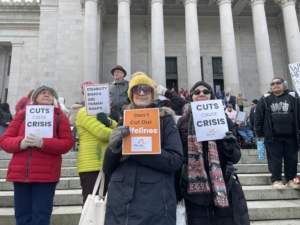
 

Good news! The Governor signed all our priority bills that passed the legislature, and he approved the budget.  There were two vetoes in the budget that affect developmental disability services (DDCS/DDA) specifically.

VETO: Dental services at RHCs proviso
A budget proviso directed DSHS to pilot the use of dental capacity at Residential Habilitation Centers (RHCs) for people with IDD living in the community. The Governor vetoed that proviso but made two remarkable acknowledgements:

“Two of the four residential habilitation centers are expected to close once the census reaches a certain threshold, making this only a temporary solution to a long-term barrier to community services.” 

The Governor also recognized the extraordinary barriers to receiving dental services for people with IDD and the need for long-term solutions. He then directed the Department of Social and Health Services and the Health Care Authority, in partnership with representatives from the dentistry profession, “to continue to develop a plan to expand access to dental services for individuals with developmental disabilities in the community. This plan must align with the state’s commitment to community-based living by exploring sustainable solutions for providers in the same communities in which these clients reside.” That planning directive offers hope for real and sustainable solutions.

VETO: DSHS Re-organization
The Governor also vetoed budget language authorizing the Department of Social and Health Services (DSHS) “re-imagine” reorganization project because the Legislature did not pass implementing legislation or provide funding for it. So what does that mean? Everything old is new again.

Just when you think you have the new acronym down, the Developmental Disabilities Community Services DDCS is now back to being an administration, and the name has reverted to The Developmental Disabilities Administration (DDA).

The Rollback: DDA is back

DSHS is increasingly concerned about unnecessary scrutiny from Federal agencies (Centers for Medicare and Medicaid Services), and that the changes, especially without direction from the legislature, may make them a target that could put their federal matching dollars at risk. So, the DDA rollback is an effort to simplify and avoid complicating things too much.

Leadership  update 

Dana Phelps is the new DDA Assistant Secretary. She previously led the Division of Vocational Rehabilitation and has 35 year at DSHS in roles including juvenile justice, child welfare and legislative leadership.  You can read Dana’s introductory note here.

Reimagine DSHS: Frequently Asked Questions | DSHS

What can we expect?

Beyond the name change, you should not see differences- your service providers or your case manager will remain the same.  We heard from leadership that they will continue to work together as a team, and their commitment to the principles around re-imagine for better coordination and easier access has not changed.

Bea Rector, Assistant Secretary of HCLA had this to say:“The takeaway from this message is that while we are making this necessary change, please know that our commitment to you, and the people we serve, remains the same.”

Why the 10-year strategic plan matters

With these organizational changes underway, the 10-year strategic plan for developmental disabilities is more important now than ever. We were able to secure funding this past session to make this plan happen, and now we have is an opportunity to shape the future of our services and determine the best path forward to ensure that our community services are robust. The hope is that in 10 years, we will look back and see that true progress has been made toward accessible services that provide inclusion and a full life for individuals with IDD.

Federal concerns: family caregivers and Medicaid
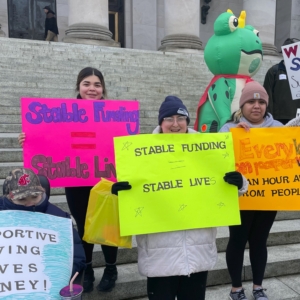
At the Federal level, there have been serious concerns about comments made by Health and Human Services (HHS) Secretary, Robert F. Kennedy Jr., and the Center for Medicare and Medicaid (CMS) Secretary, Mehmet Oz, regarding family caregivers taht characterize paying them as wasteful, fraudulent, or abusive and suggest families should provide care for free.  The pushback has been swift from both disability advocacy organizations and families.

Family caregivers are the backbone of our care system, especially as we face a national workforce crisis.  Their work isn’t just a service; it is what prevents our loved ones from being forced into costly, restrictive institutions. When individuals have the right to choose their own providers—including their own family—it gives them the opportunity to be independent and have access to the community they deserve.  Family providers are a vital win-win for both families and the system.

Washington families sue the state

Family caregivers are in the spotlight closer to home. Families of children with IDD are suing Washington state, alleging the state fails to ensure that Medicaid-eligible children receive the nursing and care services they qualify for. The outcome desired is that parents of minor children who receive personal care or nursing hours could be paid for caring for their loved one.

Read more about the lawsuit here.

The next few months will be important- for federal issues, the reorganization of DDA and the beginning of the 10-year strategic planning that will shape services for years to come. Stay engages: watch for alerts, reach out to legislators, and stay connected to ensure community-based, quality servvices for people with IDD remain the priority.


In Community,

Cathy Murahashi

Public Policy Specialist

The Arc of Washington State
The Arc of Washington State responds to Kennedy’s comments about family caregivers

Statement by Stacy Dym, Executive Director of The Arc of Washington State, regarding Kennedy’s comments about community-based services and family caregivers

“The recent statements by HHS Secretary Robert F. Kennedy Jr. and CMS Administrator Mehmet Oz are a gross misrepresentation of the essential support provided by family caregivers in our country. In Washington state, seventy-eight percent of people with intellectual and developmental disabilities (IDD) live with and receive care from a parent or a relative. The systems we have to provide the most basic services for people with intellectual and developmental disabilities are barely sufficient to meet family’s needs. For the parents and family members who provide life-giving care to their loved ones with IDD, financial compensation through Medicaid is often the only reliable option for caregiving.

The value of family caregivers is immeasurable. Kennedy’s claims of widespread fraud by family members are unsupported at best and harmful at worst.

Despite the harmful national rhetoric, Washington state has rightly prioritized investments in community-based services as we continue our decades-long transition away from isolating and outdated institutional care. The Arc of Washington State stands with family caregivers and we urge the federal government to refrain from misrepresenting the invaluable care they provide every day.”

For questions, please contact our team at media@arcwa.org.

It’s Over: Sine Die

We made it through legislative session—hurray. It was quite a show: a record-breaking 24-hour House floor debate over the millionaire tax, a Senator using an offensive slur about developmental disabilities on the floor, and, as the House prepared to vote on the final operating budget, a fire alarm went off that evacuated the Capitol. You couldn’t make this stuff up.

Winspriority bills headed to the Governor.  As it comes to a close, we have much to celebrate! Because of budget constraints, most bills had to be “policy only” (no new funding). Several of our priority bills cleared the process and are on their way to the Governor:

  • SB 5863 An Act relating to the Preservation and inspection of state historical records: Protects historic records stored at Lakeland Village, ensuring they are not destroyed before 2030. These records are essential to telling the history of people with developmental disabilities.
  • SHB 2350Increasing RHC compliance transparency: Requires notification to residents and guardians when a Residential Habilitation Center (RHC) is out of compliance with federal Medicare/Medicaid requirements.
  • SHB 1390Repealing the Community Protection Program: Eliminates an overly restrictive program for people with developmental disabilities who have had legal involvement. The program goes away, but services and supports to the individual do not. (Note: this is distinct from the Community Protect Act, which addresses sex offenders.)
  • ESHB 1795Addressing Restraint and isolation of students in public schools: Prohibits particularly egregious restraints and bans construction of new isolation rooms. It’s an important step forward, though more work remains.
  • SHB 2230Streamlining monitoring and oversight activities for related to community residential service providers: This smart bill brought by Community Residential Services Alliance (CRSA), reduces duplicated inspections and audits, saving provider and state staff time and ultimately money.

Other notable bills that passed

  • 2SSB 6035Access to voting for military, overseas, Native American, and disabled voters and provides an accessible voting portal for blind or low vision individuals.
  • 2SSB 5969Fulfilling high school and beyond plan requirements with individualized education program transition plans.
  • SSB 6268Maintaining an online record of special education complaint decisions. Provides access to previous complaints to families, individuals, districts, and others.
  • SHB 2323— Establishing a blue envelope program. Provides for neurodivergent drivers to carry a blue envelope in the car that explains their disability if they are pulled over.
  • ESSB 5156Concerning Elevator standards for smaller apartment buildings: Mixed reactions in the disability community—may increase housing access but raises safety concerns for larger wheelchairs or gurney evacuations.

Disappointments — priority bills that stalled

  • ESHB 2319— Renaming state residential habilitation centers (RHC) for persons with developmental disabilities: Would have removed “School” from RHC names to reduce confusion. Passed both chambers but died in the Senate Rules Committee. Expect it to return.
  • HB 2415— Reporting on unexpected fatalities in DSHS facilities: Would have created a process and data reporting for unexpected deaths in RHCs and other residential settings; it died due to cost in a tight budget year.

You can view all the bills we tracked here: Note that there are three tabs at the bottom- priority bills, broader bills we tracked, and bills that died

Budget Outcomes: There is a lot of red ink, but thanks to your amazing advocacy the worst proposals did not materialize— we were heard!

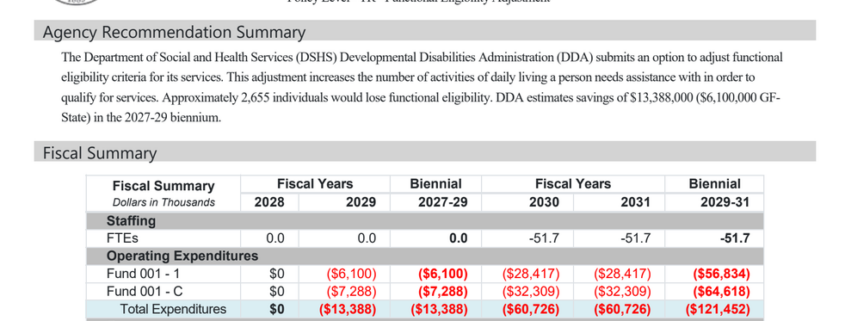
  • No changes to Long Term Care eligibility or the DD waiver (avoided potential loss of services for ~2,500 people).
  • No provider rate cuts — protecting provider networks and workforce.
  • No cuts to Birth-to-Three/ESIT funding — avoided a proposed rollback that would have cut about $30 million.
  • No elimination of adult Medicaid therapies (OT, PT, SLP). Making sure people continue to have access to these vital services.
  • No cuts to school-based Medicaid match funding — the House’s proposed 25% state match cut did not make the final budget.

Close calls and remaining concerns

Both chambers initially proposed reclaiming nearly $33M as an “underspend” from Employment, Day, and Individual & Family Support services. OFM later told the Legislature that this was a significant overestimate. The miscalculation would have caused devastating cuts to DDCS services and potentially could have led to shutting the front door to Waiver services, cuts in community-based programs like Parent to Parent, Informing Families, and BenefitU.

Thankfully, the final budget scaled the takeback to about $12M. Since the actual projected underspend is estimated between $0–$8M, this likely still represents a cut. We are assessing impacts; it may delay access to waivers impacting high school grads and children waiting for Individual and Family Services.

Senators Kauffman, Trudeau, Claire Wilson, Torress, WArnick, Frame, and Conway with Lt. Governor Denny Heck and DD Advocates for Senate Resolution 8689. March 10, 2026.

Big win in planning

The final budget includes $250,000 for a comprehensive 10-year DDCS plan to expand community-based services and reduce reliance on congregate institutional settings. Funding comes from the Dan Thompson Memorial Account. This planning effort is an important opportunity to build capacity and secure legislative attention for long-term system improvements for the Community.

Accountability and culture change

After the Senate-floor slur incident, self-advocates organized a letter signed by more than 150 organizations and individuals. Senate leadership from both parties met with advocates and issued sincere apologies. The Republican caucus took quick action, removing Senator Christian from the DCYF oversight committee; additional committee actions are pending.

We know we have far to go in the education of our community about the importance and humanity of individuals with I/DD, but the telling moment on the Senate floor was the audible gasp when the horrid slur was used. It showed that although one person was uneducated, the rest of those in the room recognized how wrong it was. The swift and sincere remorse from leadership tells us we have made progress.

Thank you — your voice mattered. Your advocacy made a difference. Your pushback prevented truly harmful cuts and convinced legislators to act differently. We have champions in the Legislature and a growing coalition across and beyond the DD community—essential for protecting services going forward.

“And miles to go before I sleep.”

In Community,

Cathy Murahashi


Our Words Matter: a blog by self-advocates Jessica and Shawn

Words should be used with respect to human beings, including those with intellectual and developmental disabilities. Words should never be used to discriminate or dehumanize individuals.

Written By Jessica Renner and Shawn Latham from Self-Advocates In Leadership

Wednesday, March 4th,, 2026, on the floor of the Washington State Senate, Senator Leonard Christian from the 4th District in Spokane used the R-word while speaking on HB 1390, the Community Protection Bill.  The R word has been used over the years to put down and diminish the value of people with disabilities, especially those with intellectual disabilities. In the past, students, teachers, doctors, therapists, community members, and even family members have used the R word in anger or to humiliate those with intellectual and developmental disabilities. Self-advocates from across the State are disgusted with not only Senator Christian’s comments on the Senate Floor but his ongoing refusal to apologize for the R-word comment in local newspapers. One self-advocate from Spokane stated that while his comment was horrible to hear, unfortunately, the comment is not surprising because there had been an uptick in people using discriminatory language lately in the Spokane area.

Starting in 2004, Self Advocates in Leadership (SAIL), and a coalition of people with intellectual and developmental disabilities who work on public policy at the State Level, helped to pass three respectful language bills: HB 2663 in 2004, HB 1835 in 2009, and HB 2490 in 2010. These bills remove the R-word and other outdated, disrespectful language from all past, present, and future State laws and documents. In particular, HB 1835 replaced any reference to the “MR-words” with intellectual disability. Senator Christian is out of step with Washington’s movement toward respectful language, as these three bills reflect.

We feel that Senator Christian’s words were not only out of line because of his use of the R-word, but his ableist remarks about people with I/DD being too vulnerable to understand what is going on.  These actions are a public reminder  that many people unfortunately still think of adults with intellectual and developmental disabilities as children who can’t make decisions for themselves in their lives.

The SAIL Coalition believes the R-word is harmful not because people are “too sensitive,” but because it carries decades of bullying, exclusion, and dehumanization. Ending its use is a small but powerful step toward building a society where people with disabilities are treated with the dignity, respect, and belonging they deserve.

In 2004, all legislators agreed that the R-word shouldn’t be used when the Respectful Language Act was passed. We do not want to go backwards in time to a place where the R-word was used repeatedly.

It is due time that all of us, including our state legislators, fully understand how hurtful the R-word is and commit never to use it again.

It is time that the intellectual and developmental disability community as a whole works together to educate lawmakers and community members that using the R-word is hurtful and not okay to use at any time.


Why Using the R-Word is Unacceptable:

  1. It Is a Slur That Dehumanizes People
  2. It Fuels Bullying and Social Exclusion
  3. It Undermines the Dignity and Rights of People with Disabilities
  4. Leaders Should Model Respect


You may read about the incident in these three news articles.

The Spokane Review

The Seattle Times

State Standard

If you are interested in signing on to a letter that is going to Senate Leadership. You can read the letter and sign on as an individual, or as your organization here.

Statement in response to Senator’s offensive use of the R-word slur in floor debate

CONTACT: Stacy Dym, media@arcwa.org, Executive Director of The Arc of Washington State

The following statement is from Stacy Dym, Executive Director of The Arc of Washington State, the state’s oldest grassroots organization advocating for the rights and inclusion of people with intellectual and developmental disabilities (IDD) and their families for over 90 years, in response to the use of a slur for people with intellectual and developmental disabilities on the floor of the Washington State Senate.

“It is appalling that people with intellectual and developmental disabilities must witness the use of such dehumanizing language by their elected official, especially as the legislature is already considering sweeping $30 million cuts to disability services and eliminating coverage of essential physical and occupational therapies for all Medicaid recipients. The Senator’s comments are unacceptable in all contexts, and they unfortunately contribute to the further erosion of the humanity of people with developmental disabilities who deserve to live and work as valued members of their communities.

Although the R-word was introduced as a neutral medical term for people with intellectual and developmental disabilities over sixty years ago, it quickly became a cruel insult that carried the painful weight of discrimination, harassment, stigma, and prejudice. Language matters, especially from our leaders, and this word is no longer acceptable to use outside of historical documents.

If the legislature truly wants to prioritize the humanity of people with intellectual and developmental disabilities, they should pay close attention to what’s in their budgets and their current proposal to effectively shut the front door on disability services in Washington state.”

The details of the devastating $30 million cut being proposed for disability services can be found here in a recent press release from The Arc of Washington State.

You can take action HERE to write to your legislators now and urge them to stop these proposed cuts to essential disability services.

The details of the proposed elimination of coverage for physical and occupational therapies for adult Medicaid recipients can be found here in a recent joint press release. 

Recent newspaper coverage of the Senator’s use of the slur and his subsequent refusal to apologize can be found here:

WA GOP senator uses slur on Senate floor, doubles down – March 6, 2026, The Seattle Times, by Sophia Sostrin

Spokane Valley Sen. Leonard Christian draws rebuke over ‘inflaming’ remarks in floor speech, March 5, 2026, The Spokesman-Review, by Mitchell Roland

WA senator refuses to apologize for inflammatory remark, March 5, 2026, Washington State Standard, by Jake Goldstein-Street


Disability advocates warn of budget cut based on incorrect estimate of underspent funds

FOR IMMEDIATE RELEASE:

March 3, 2026

CONTACT: Stacy Dym, media@arcwa.org, Executive Director of The Arc of Washington State

Legislative budget proposals will “shut the front door” for disability services based on incorrect estimate of underspent funds

OLYMPIA, WA – A statewide alliance of sixty-eight organizations are warning the legislature that the proposed budgets in the House and the Senate will force the state to stop providing services for any new individuals with intellectual and developmental disabilities, including recent high school graduates.

The alliance, including the statewide membership of the Community Advocacy Coalition for Developmental Disabilities, is urging the legislature to immediately reject their proposed cuts to waiver services provided by the Developmental Disabilities Community Services. The $30 million cuts in both budgets are being proposed as an opportunity to “sweep” projected underspend by the department. The Office of Financial Management (OFM) has verified that numbers are based on inaccurate estimates of underspend that had already been “swept” back in the 2025-27 biennial budget. The coalition is urging the legislature to demand a corrected fiscal analysis.

The group sent a letter outlining their opposition and concerns to Senate and House Budget Committee Chairs on March 2, 2026. The full text of the letter can be viewed at this link.

As written by the Community Advocacy Coalition in the letter:

“These cuts are not grounded in fiscal reality. If they pass, they function the same as eligibility cuts, since DDCS would be forced to shut the front door to services by reducing the cap on waiver enrollment.  All services are impacted when the cap on HCBS waiver enrollment is reduced. This includes residential, employment, respite, family, and therapy supports. Parent to Parent programs, Informing Families, and other community-based family support programming would be the first programs on the chopping block.”

The coalition referenced a letter sent by OFM Director K.D. Chapmen to legislative budget leaders on February 26, 2026 that highlights the miscalculation in the proposed cut. The letter included:

“Both the House and Senate assume savings related to program underspending for the Individual and Family Services (IFS) waiver and employment and day services. The House and Senate budgets assume similar savings of $32 million and $33 million, respectively. These programs have historically been underspent; however, the 2025-27 biennial budget already reduced the IFS budget by $50 million per biennium. The agency does not believe the program can absorb this additional, large reduction without negatively impacting service delivery to clients.

Stacy Dym, Executive Director of The Arc of Washington state, said in a statement:

“The legislature is working under a false assumption that there is money to cut in developmental disability services, but they are disastrously mistaken. They have already made the cuts they’re proposing and if they continue forward, they will be shutting out families in crisis who have nowhere to turn for support. This cut will also leave students with developmental disabilities who are transitioning out of high school completely without services to get jobs, remain independent, and live in their community successfully. This isn’t just unacceptable – it’s a devastating mistake.”

About The Arc of Washington State

In 1936, The Arc of Washington State was formed by parents of institutionalized children with intellectual/developmental disabilities (IDD) who believed their children deserved more – to be included in their communities and to pursue fulfillment and happiness just like everyone else. The Arc has played a pivotal role in changing the public perception of disability and demanding better opportunities for every child’s future. The Arc’s mission is to promote and protect the human rights of people with intellectual and developmental disabilities and actively support their full inclusion and participation in the community throughout their lifetimes. Learn more about The Arc of Washington State at arcwa.org.
About the Community Advocacy Coalition for Developmental Disabilities (CAC)

The Community Advocacy Coalition for Developmental Disabilities (CAC) is a grassroots coalition for developmental disabilities that advocates with a common voice for meaningful community living for people with developmental disabilities at the state and local levels. CAC membership consists of any community-based organization that is a nonprofit 501c3, a private business, a chapter of a statewide nonprofit organization, or a governmental association, council, coalition, board or commission that have a primary focus to support, serve and advocate for people with developmental disabilities. The CAC is comprised of over 50 different member organizations that agree to support the core values of the CAC and agree to abide by the group’s responsibilities/rules.

###