It’s Over: Sine Die

We made it through legislative session—hurray. It was quite a show: a record-breaking 24-hour House floor debate over the millionaire tax, a Senator using an offensive slur about developmental disabilities on the floor, and, as the House prepared to vote on the final operating budget, a fire alarm went off that evacuated the Capitol. You couldn’t make this stuff up.

Winspriority bills headed to the Governor.  As it comes to a close, we have much to celebrate! Because of budget constraints, most bills had to be “policy only” (no new funding). Several of our priority bills cleared the process and are on their way to the Governor:

  • SB 5863 An Act relating to the Preservation and inspection of state historical records: Protects historic records stored at Lakeland Village, ensuring they are not destroyed before 2030. These records are essential to telling the history of people with developmental disabilities.
  • SHB 2350Increasing RHC compliance transparency: Requires notification to residents and guardians when a Residential Habilitation Center (RHC) is out of compliance with federal Medicare/Medicaid requirements.
  • SHB 1390Repealing the Community Protection Program: Eliminates an overly restrictive program for people with developmental disabilities who have had legal involvement. The program goes away, but services and supports to the individual do not. (Note: this is distinct from the Community Protect Act, which addresses sex offenders.)
  • ESHB 1795Addressing Restraint and isolation of students in public schools: Prohibits particularly egregious restraints and bans construction of new isolation rooms. It’s an important step forward, though more work remains.
  • SHB 2230Streamlining monitoring and oversight activities for related to community residential service providers: This smart bill brought by Community Residential Services Alliance (CRSA), reduces duplicated inspections and audits, saving provider and state staff time and ultimately money.

Other notable bills that passed

  • 2SSB 6035Access to voting for military, overseas, Native American, and disabled voters and provides an accessible voting portal for blind or low vision individuals.
  • 2SSB 5969Fulfilling high school and beyond plan requirements with individualized education program transition plans.
  • SSB 6268Maintaining an online record of special education complaint decisions. Provides access to previous complaints to families, individuals, districts, and others.
  • SHB 2323— Establishing a blue envelope program. Provides for neurodivergent drivers to carry a blue envelope in the car that explains their disability if they are pulled over.
  • ESSB 5156Concerning Elevator standards for smaller apartment buildings: Mixed reactions in the disability community—may increase housing access but raises safety concerns for larger wheelchairs or gurney evacuations.

Disappointments — priority bills that stalled

  • ESHB 2319— Renaming state residential habilitation centers (RHC) for persons with developmental disabilities: Would have removed “School” from RHC names to reduce confusion. Passed both chambers but died in the Senate Rules Committee. Expect it to return.
  • HB 2415— Reporting on unexpected fatalities in DSHS facilities: Would have created a process and data reporting for unexpected deaths in RHCs and other residential settings; it died due to cost in a tight budget year.

You can view all the bills we tracked here: Note that there are three tabs at the bottom- priority bills, broader bills we tracked, and bills that died

Budget Outcomes: There is a lot of red ink, but thanks to your amazing advocacy the worst proposals did not materialize— we were heard!

  • No changes to Long Term Care eligibility or the DD waiver (avoided potential loss of services for ~2,500 people).
  • No provider rate cuts — protecting provider networks and workforce.
  • No cuts to Birth-to-Three/ESIT funding — avoided a proposed rollback that would have cut about $30 million.
  • No elimination of adult Medicaid therapies (OT, PT, SLP). Making sure people continue to have access to these vital services.
  • No cuts to school-based Medicaid match funding — the House’s proposed 25% state match cut did not make the final budget.

Close calls and remaining concerns

Both chambers initially proposed reclaiming nearly $33M as an “underspend” from Employment, Day, and Individual & Family Support services. OFM later told the Legislature that this was a significant overestimate. The miscalculation would have caused devastating cuts to DDCS services and potentially could have led to shutting the front door to Waiver services, cuts in community-based programs like Parent to Parent, Informing Families, and BenefitU.

Thankfully, the final budget scaled the takeback to about $12M. Since the actual projected underspend is estimated between $0–$8M, this likely still represents a cut. We are assessing impacts; it may delay access to waivers impacting high school grads and children waiting for Individual and Family Services.
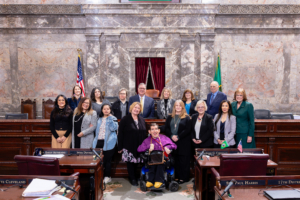
Senators Kauffman, Trudeau, Claire Wilson, Torress, WArnick, Frame, and Conway with Lt. Governor Denny Heck and DD Advocates for Senate Resolution 8689. March 10, 2026.

Big win in planning

The final budget includes $250,000 for a comprehensive 10-year DDCS plan to expand community-based services and reduce reliance on congregate institutional settings. Funding comes from the Dan Thompson Memorial Account. This planning effort is an important opportunity to build capacity and secure legislative attention for long-term system improvements for the Community.

Accountability and culture change

After the Senate-floor slur incident, self-advocates organized a letter signed by more than 150 organizations and individuals. Senate leadership from both parties met with advocates and issued sincere apologies. The Republican caucus took quick action, removing Senator Christian from the DCYF oversight committee; additional committee actions are pending.

We know we have far to go in the education of our community about the importance and humanity of individuals with I/DD, but the telling moment on the Senate floor was the audible gasp when the horrid slur was used. It showed that although one person was uneducated, the rest of those in the room recognized how wrong it was. The swift and sincere remorse from leadership tells us we have made progress.

Thank you — your voice mattered. Your advocacy made a difference. Your pushback prevented truly harmful cuts and convinced legislators to act differently. We have champions in the Legislature and a growing coalition across and beyond the DD community—essential for protecting services going forward.

“And miles to go before I sleep.”

In Community,

Cathy Murahashi

 

Our Words Matter: a blog by self-advocates Jessica and Shawn

Words should be used with respect to human beings, including those with intellectual and developmental disabilities. Words should never be used to discriminate or dehumanize individuals.

Written By Jessica Renner and Shawn Latham from Self-Advocates In Leadership

Wednesday, March 4th,, 2026, on the floor of the Washington State Senate, Senator Leonard Christian from the 4th District in Spokane used the R-word while speaking on HB 1390, the Community Protection Bill.  The R word has been used over the years to put down and diminish the value of people with disabilities, especially those with intellectual disabilities. In the past, students, teachers, doctors, therapists, community members, and even family members have used the R word in anger or to humiliate those with intellectual and developmental disabilities. Self-advocates from across the State are disgusted with not only Senator Christian’s comments on the Senate Floor but his ongoing refusal to apologize for the R-word comment in local newspapers. One self-advocate from Spokane stated that while his comment was horrible to hear, unfortunately, the comment is not surprising because there had been an uptick in people using discriminatory language lately in the Spokane area.

Starting in 2004, Self Advocates in Leadership (SAIL), and a coalition of people with intellectual and developmental disabilities who work on public policy at the State Level, helped to pass three respectful language bills: HB 2663 in 2004, HB 1835 in 2009, and HB 2490 in 2010. These bills remove the R-word and other outdated, disrespectful language from all past, present, and future State laws and documents. In particular, HB 1835 replaced any reference to the “MR-words” with intellectual disability. Senator Christian is out of step with Washington’s movement toward respectful language, as these three bills reflect.

We feel that Senator Christian’s words were not only out of line because of his use of the R-word, but his ableist remarks about people with I/DD being too vulnerable to understand what is going on.  These actions are a public reminder  that many people unfortunately still think of adults with intellectual and developmental disabilities as children who can’t make decisions for themselves in their lives.

The SAIL Coalition believes the R-word is harmful not because people are “too sensitive,” but because it carries decades of bullying, exclusion, and dehumanization. Ending its use is a small but powerful step toward building a society where people with disabilities are treated with the dignity, respect, and belonging they deserve.

In 2004, all legislators agreed that the R-word shouldn’t be used when the Respectful Language Act was passed. We do not want to go backwards in time to a place where the R-word was used repeatedly.

It is due time that all of us, including our state legislators, fully understand how hurtful the R-word is and commit never to use it again.

It is time that the intellectual and developmental disability community as a whole works together to educate lawmakers and community members that using the R-word is hurtful and not okay to use at any time.


Why Using the R-Word is Unacceptable:

  1. It Is a Slur That Dehumanizes People
  2. It Fuels Bullying and Social Exclusion
  3. It Undermines the Dignity and Rights of People with Disabilities
  4. Leaders Should Model Respect


You may read about the incident in these three news articles.

The Spokane Review

The Seattle Times

State Standard

If you are interested in signing on to a letter that is going to Senate Leadership. You can read the letter and sign on as an individual, or as your organization here.

Statement in response to Senator’s offensive use of the R-word slur in floor debate

CONTACT: Stacy Dym, media@arcwa.org, Executive Director of The Arc of Washington State

The following statement is from Stacy Dym, Executive Director of The Arc of Washington State, the state’s oldest grassroots organization advocating for the rights and inclusion of people with intellectual and developmental disabilities (IDD) and their families for over 90 years, in response to the use of a slur for people with intellectual and developmental disabilities on the floor of the Washington State Senate.

“It is appalling that people with intellectual and developmental disabilities must witness the use of such dehumanizing language by their elected official, especially as the legislature is already considering sweeping $30 million cuts to disability services and eliminating coverage of essential physical and occupational therapies for all Medicaid recipients. The Senator’s comments are unacceptable in all contexts, and they unfortunately contribute to the further erosion of the humanity of people with developmental disabilities who deserve to live and work as valued members of their communities.

Although the R-word was introduced as a neutral medical term for people with intellectual and developmental disabilities over sixty years ago, it quickly became a cruel insult that carried the painful weight of discrimination, harassment, stigma, and prejudice. Language matters, especially from our leaders, and this word is no longer acceptable to use outside of historical documents.

If the legislature truly wants to prioritize the humanity of people with intellectual and developmental disabilities, they should pay close attention to what’s in their budgets and their current proposal to effectively shut the front door on disability services in Washington state.”

The details of the devastating $30 million cut being proposed for disability services can be found here in a recent press release from The Arc of Washington State.

You can take action HERE to write to your legislators now and urge them to stop these proposed cuts to essential disability services.

The details of the proposed elimination of coverage for physical and occupational therapies for adult Medicaid recipients can be found here in a recent joint press release. 

Recent newspaper coverage of the Senator’s use of the slur and his subsequent refusal to apologize can be found here:

WA GOP senator uses slur on Senate floor, doubles down – March 6, 2026, The Seattle Times, by Sophia Sostrin

Spokane Valley Sen. Leonard Christian draws rebuke over ‘inflaming’ remarks in floor speech, March 5, 2026, The Spokesman-Review, by Mitchell Roland

WA senator refuses to apologize for inflammatory remark, March 5, 2026, Washington State Standard, by Jake Goldstein-Street


Disability advocates warn of budget cut based on incorrect estimate of underspent funds

FOR IMMEDIATE RELEASE:

March 3, 2026

CONTACT: Stacy Dym, media@arcwa.org, Executive Director of The Arc of Washington State

Legislative budget proposals will “shut the front door” for disability services based on incorrect estimate of underspent funds

OLYMPIA, WA – A statewide alliance of sixty-eight organizations are warning the legislature that the proposed budgets in the House and the Senate will force the state to stop providing services for any new individuals with intellectual and developmental disabilities, including recent high school graduates.

The alliance, including the statewide membership of the Community Advocacy Coalition for Developmental Disabilities, is urging the legislature to immediately reject their proposed cuts to waiver services provided by the Developmental Disabilities Community Services. The $30 million cuts in both budgets are being proposed as an opportunity to “sweep” projected underspend by the department. The Office of Financial Management (OFM) has verified that numbers are based on inaccurate estimates of underspend that had already been “swept” back in the 2025-27 biennial budget. The coalition is urging the legislature to demand a corrected fiscal analysis.

The group sent a letter outlining their opposition and concerns to Senate and House Budget Committee Chairs on March 2, 2026. The full text of the letter can be viewed at this link.

As written by the Community Advocacy Coalition in the letter:

“These cuts are not grounded in fiscal reality. If they pass, they function the same as eligibility cuts, since DDCS would be forced to shut the front door to services by reducing the cap on waiver enrollment.  All services are impacted when the cap on HCBS waiver enrollment is reduced. This includes residential, employment, respite, family, and therapy supports. Parent to Parent programs, Informing Families, and other community-based family support programming would be the first programs on the chopping block.”

The coalition referenced a letter sent by OFM Director K.D. Chapmen to legislative budget leaders on February 26, 2026 that highlights the miscalculation in the proposed cut. The letter included:

“Both the House and Senate assume savings related to program underspending for the Individual and Family Services (IFS) waiver and employment and day services. The House and Senate budgets assume similar savings of $32 million and $33 million, respectively. These programs have historically been underspent; however, the 2025-27 biennial budget already reduced the IFS budget by $50 million per biennium. The agency does not believe the program can absorb this additional, large reduction without negatively impacting service delivery to clients.

Stacy Dym, Executive Director of The Arc of Washington state, said in a statement:

“The legislature is working under a false assumption that there is money to cut in developmental disability services, but they are disastrously mistaken. They have already made the cuts they’re proposing and if they continue forward, they will be shutting out families in crisis who have nowhere to turn for support. This cut will also leave students with developmental disabilities who are transitioning out of high school completely without services to get jobs, remain independent, and live in their community successfully. This isn’t just unacceptable – it’s a devastating mistake.”

About The Arc of Washington State

In 1936, The Arc of Washington State was formed by parents of institutionalized children with intellectual/developmental disabilities (IDD) who believed their children deserved more – to be included in their communities and to pursue fulfillment and happiness just like everyone else. The Arc has played a pivotal role in changing the public perception of disability and demanding better opportunities for every child’s future. The Arc’s mission is to promote and protect the human rights of people with intellectual and developmental disabilities and actively support their full inclusion and participation in the community throughout their lifetimes. Learn more about The Arc of Washington State at arcwa.org.

About the Community Advocacy Coalition for Developmental Disabilities (CAC)

The Community Advocacy Coalition for Developmental Disabilities (CAC) is a grassroots coalition for developmental disabilities that advocates with a common voice for meaningful community living for people with developmental disabilities at the state and local levels. CAC membership consists of any community-based organization that is a nonprofit 501c3, a private business, a chapter of a statewide nonprofit organization, or a governmental association, council, coalition, board or commission that have a primary focus to support, serve and advocate for people with developmental disabilities. The CAC is comprised of over 50 different member organizations that agree to support the core values of the CAC and agree to abide by the group’s responsibilities/rules.

###