It’s Over: Sine Die
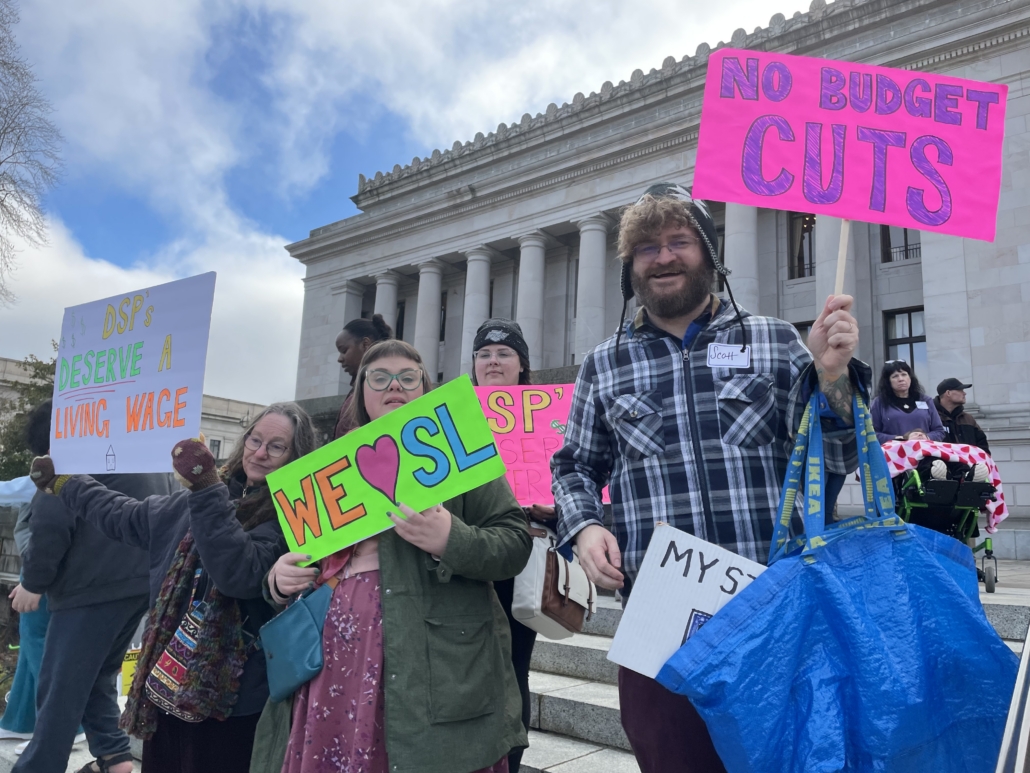
We made it through legislative session—hurray. It was quite a show: a record-breaking 24-hour House floor debate over the millionaire tax, a Senator using an offensive slur about developmental disabilities on the floor, and, as the House prepared to vote on the final operating budget, a fire alarm went off that evacuated the Capitol. You couldn’t make this stuff up.
Wins — priority bills headed to the Governor. As it comes to a close, we have much to celebrate! Because of budget constraints, most bills had to be “policy only” (no new funding). Several of our priority bills cleared the process and are on their way to the Governor:
- SB 5863 — An Act relating to the Preservation and inspection of state historical records: Protects historic records stored at Lakeland Village, ensuring they are not destroyed before 2030. These records are essential to telling the history of people with developmental disabilities.
- SHB 2350— Increasing RHC compliance transparency: Requires notification to residents and guardians when a Residential Habilitation Center (RHC) is out of compliance with federal Medicare/Medicaid requirements.
- SHB 1390— Repealing the Community Protection Program: Eliminates an overly restrictive program for people with developmental disabilities who have had legal involvement. The program goes away, but services and supports to the individual do not. (Note: this is distinct from the Community Protect Act, which addresses sex offenders.)
- ESHB 1795— Addressing Restraint and isolation of students in public schools: Prohibits particularly egregious restraints and bans construction of new isolation rooms. It’s an important step forward, though more work remains.
- SHB 2230— Streamlining monitoring and oversight activities for related to community residential service providers: This smart bill brought by Community Residential Services Alliance (CRSA), reduces duplicated inspections and audits, saving provider and state staff time and ultimately money.
Other notable bills that passed
- 2SSB 6035— Access to voting for military, overseas, Native American, and disabled voters and provides an accessible voting portal for blind or low vision individuals.
- 2SSB 5969– Fulfilling high school and beyond plan requirements with individualized education program transition plans.
- SSB 6268— Maintaining an online record of special education complaint decisions. Provides access to previous complaints to families, individuals, districts, and others.
- SHB 2323— Establishing a blue envelope program. Provides for neurodivergent drivers to carry a blue envelope in the car that explains their disability if they are pulled over.
- ESSB 5156— Concerning Elevator standards for smaller apartment buildings: Mixed reactions in the disability community—may increase housing access but raises safety concerns for larger wheelchairs or gurney evacuations.
Disappointments — priority bills that stalled
- ESHB 2319— Renaming state residential habilitation centers (RHC) for persons with developmental disabilities: Would have removed “School” from RHC names to reduce confusion. Passed both chambers but died in the Senate Rules Committee. Expect it to return.
- HB 2415— Reporting on unexpected fatalities in DSHS facilities: Would have created a process and data reporting for unexpected deaths in RHCs and other residential settings; it died due to cost in a tight budget year.

You can view all the bills we tracked here: Note that there are three tabs at the bottom- priority bills, broader bills we tracked, and bills that died
Budget Outcomes: There is a lot of red ink, but thanks to your amazing advocacy the worst proposals did not materialize— we were heard!
- No changes to Long Term Care eligibility or the DD waiver (avoided potential loss of services for ~2,500 people).
- No provider rate cuts — protecting provider networks and workforce.
- No cuts to Birth-to-Three/ESIT funding — avoided a proposed rollback that would have cut about $30 million.
- No elimination of adult Medicaid therapies (OT, PT, SLP). Making sure people continue to have access to these vital services.
- No cuts to school-based Medicaid match funding — the House’s proposed 25% state match cut did not make the final budget.
Close calls and remaining concerns
Both chambers initially proposed reclaiming nearly $33M as an “underspend” from Employment, Day, and Individual & Family Support services. OFM later told the Legislature that this was a significant overestimate. The miscalculation would have caused devastating cuts to DDCS services and potentially could have led to shutting the front door to Waiver services, cuts in community-based programs like Parent to Parent, Informing Families, and BenefitU.
Thankfully, the final budget scaled the takeback to about $12M. Since the actual projected underspend is estimated between $0–$8M, this likely still represents a cut. We are assessing impacts; it may delay access to waivers impacting high school grads and children waiting for Individual and Family Services.
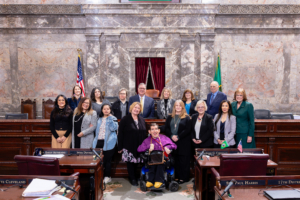
Senators Kauffman, Trudeau, Claire Wilson, Torress, WArnick, Frame, and Conway with Lt. Governor Denny Heck and DD Advocates for Senate Resolution 8689. March 10, 2026.
Big win in planning
The final budget includes $250,000 for a comprehensive 10-year DDCS plan to expand community-based services and reduce reliance on congregate institutional settings. Funding comes from the Dan Thompson Memorial Account. This planning effort is an important opportunity to build capacity and secure legislative attention for long-term system improvements for the Community.
Accountability and culture change
After the Senate-floor slur incident, self-advocates organized a letter signed by more than 150 organizations and individuals. Senate leadership from both parties met with advocates and issued sincere apologies. The Republican caucus took quick action, removing Senator Christian from the DCYF oversight committee; additional committee actions are pending.
We know we have far to go in the education of our community about the importance and humanity of individuals with I/DD, but the telling moment on the Senate floor was the audible gasp when the horrid slur was used. It showed that although one person was uneducated, the rest of those in the room recognized how wrong it was. The swift and sincere remorse from leadership tells us we have made progress.
Thank you — your voice mattered. Your advocacy made a difference. Your pushback prevented truly harmful cuts and convinced legislators to act differently. We have champions in the Legislature and a growing coalition across and beyond the DD community—essential for protecting services going forward.
“And miles to go before I sleep.”
In Community,
Cathy Murahashi